AEO vs SEO: what’s the difference?
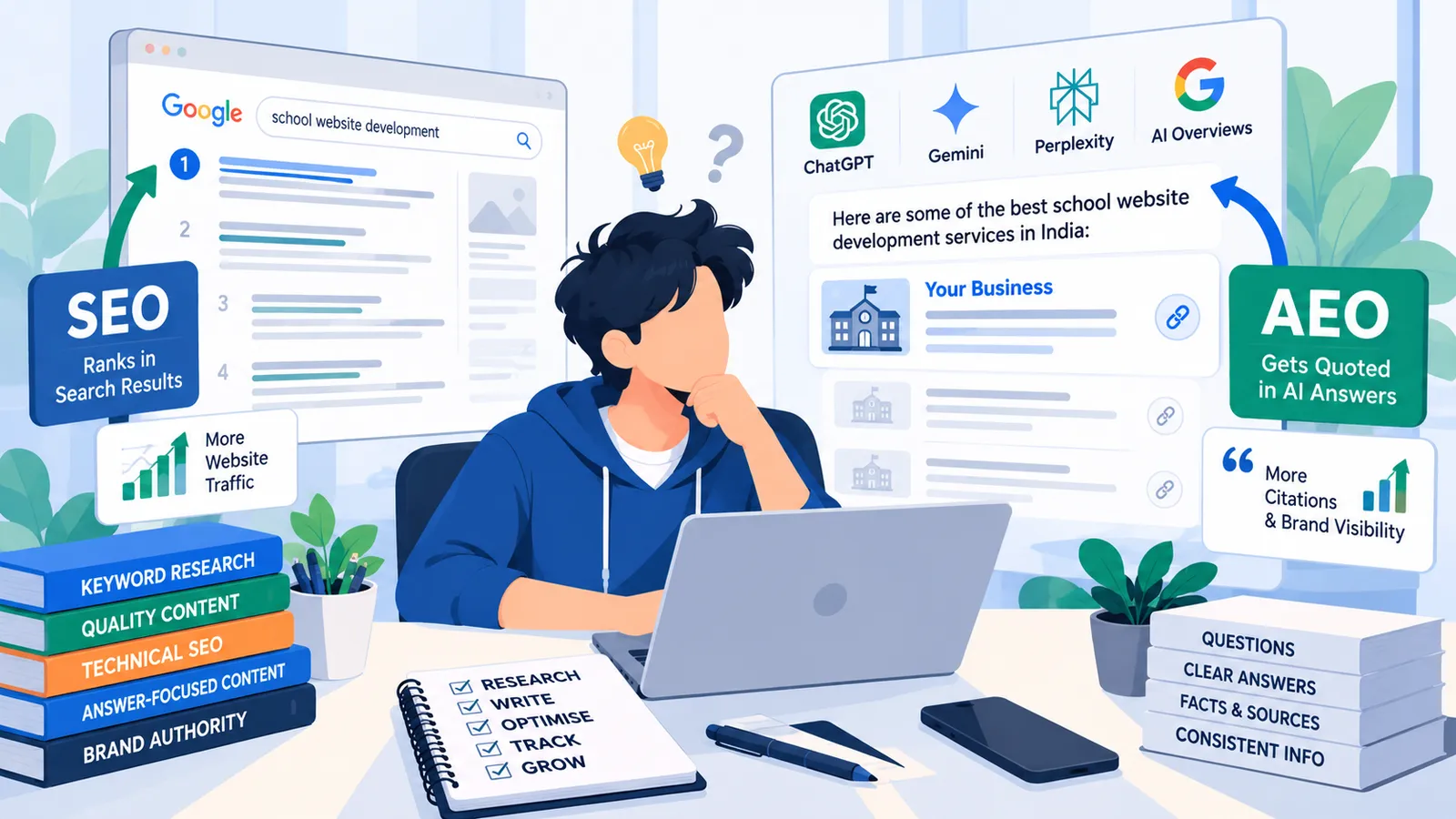
SEO (search engine optimisation) gets your pages ranked in Google’s list of results. AEO (answer engine optimisation) gets your business quoted or cited inside the answers that ChatGPT, Perplexity and Google’s AI Overviews write. Both rest on the same foundation, and AEO adds clear, quotable answers and evidence that these tools can trust.
In brief:
- AEO stands for answer engine optimisation. It aims at AI answers, voice assistants and featured snippets rather than the usual list of links.
- AI tools pull from pages that search engines can already find and trust, so AEO depends on SEO.
- The biggest practical difference is format. AEO rewards a direct answer near the top of the page and short paragraphs that make sense on their own.
- SEO is measured in rankings and clicks. AEO also looks at citations and at how AI tools describe you.
- For most small businesses the order is SEO basics first, then content shaped for answers.
People usually search “AEO vs SEO” after being told that one is replacing the other. The real answer depends on what your site already does well, and the evidence on this is still thin in places, so this piece sticks to what it supports.
What is AEO?
AEO is the practice of making your content easy for answer engines to find and quote. An answer engine is anything that replies with an answer instead of a list of links: ChatGPT, Perplexity, Gemini, Google’s AI Overviews and AI Mode, voice assistants, and the featured snippet box at the top of Google.
You’ll also see GEO (generative engine optimisation) and LLMO used for much the same idea. The term GEO comes from a 2023 paper by Aggarwal and colleagues, later accepted at KDD 2024. In their tests, targeted changes to content raised visibility in generative engine answers by up to 40%. That was measured in a lab setting and won’t translate directly to your site, though it did show that the way content is written affects what these systems use.
What is the difference between SEO and AEO?
SEO succeeds when a page ranks and someone clicks it. AEO succeeds when a passage from your page, or a mention of your business, shows up inside a generated answer, whether anyone clicks or not.
| SEO | AEO | |
|---|---|---|
| Aim | Rank a page in search results | Be quoted, cited or recommended in an answer |
| Unit that wins | The whole page | A passage, fact or brand mention |
| Where it shows | Google and Bing results pages | ChatGPT, Perplexity, AI Overviews, voice, snippets |
| Main signals | Relevance, links, technical health, content quality | All of SEO, plus clear answers and consistent facts across sources |
| Measured by | Rankings, impressions, clicks | Citations, mentions, AI referral visits, branded searches |
The two overlap more than they differ. Google says a page has to be indexed and eligible for a snippet to appear in its AI features, with no extra technical requirements beyond that. If your SEO basics are broken, AEO has nothing to build on.
Why does AEO matter now?
Fewer searches end in a click. Pew Research Center tracked the Google searches of 900 US adults in March 2025. When an AI summary appeared, people clicked a normal result in 8% of visits, compared with 15% when there was no summary. Only 1% of visits included a click on a link inside the summary.
Ranking on page one still counts. Being the page an answer is built from now counts for more than it did, and that’s the part AEO works on.
Will AEO replace SEO?
The evidence points the other way. AI tools that search the web, such as Perplexity and ChatGPT search, fetch pages much as a search engine does before they write an answer. Perplexity’s help centre says it runs a live web search and attaches numbered citations to its answers.
The emphasis does shift. A page that ranks but buries its answer under five paragraphs of introduction is hard to quote, while a page that answers in its first two sentences and then backs that up works for search engines and AI tools alike.
How to optimise for AEO: step by step
- Get the SEO basics right first: pages indexed, crawlable, reasonably fast and linked from the rest of your site. Our free SEO checklist covers these.
- Write down the questions customers actually ask you. Sales calls, WhatsApp enquiries, reviews and Google’s “People also ask” boxes are good places to look.
- Answer each question directly. Put the question in a heading and answer it in the first 40 to 60 words underneath.
- Write paragraphs that still make sense when quoted on their own.
- Back up claims with named sources, dates, prices and other specifics. Any tool will hesitate to repeat a vague claim.
- Keep your business name, services, locations and prices identical across your site, your Google Business Profile and directories.
- Ask ChatGPT, Perplexity and Gemini the questions your customers ask, and note what they get wrong or leave out about you.
Do you need both AEO and SEO?
Most businesses need both, in that order. If your site isn’t indexed properly, start with SEO; our guide on why a website doesn’t show up on Google covers the usual blockers. If it ranks reasonably well but AI tools never mention you, AEO is the next step.
Work for specific platforms comes after that. Perplexity, for instance, has its own crawler and its own way of citing sources, which is worth checking separately.
What we would do first
We’d check a few things before changing anything:
- Whether your important pages are indexed and eligible for snippets.
- What ChatGPT, Perplexity and Google’s AI Overviews say when someone asks about your service in your city.
- Whether your pages answer real questions directly or open with general introductions.
The fix is often smaller than people expect. Rewriting the opening paragraph of your ten most important pages so each one answers its question plainly can do more than publishing twenty new posts.
Related reading: how to get your business mentioned in ChatGPT and what SEO is and why it matters.
Frequently asked questions
What does AEO stand for?
AEO stands for answer engine optimisation. It means shaping your content so that tools which give direct answers, such as ChatGPT, Perplexity, Google’s AI Overviews and voice assistants, can find and quote it.
Is AEO the same as GEO?
They overlap heavily. GEO (generative engine optimisation) usually refers to AI tools that write answers, while some people use AEO more broadly to include featured snippets and voice search. In practice the work is mostly the same.
Is AEO better than SEO?
They do different jobs. SEO gets your pages found and ranked, and AEO helps those pages get quoted in answers. AEO struggles on a site whose SEO foundations are weak.
How long does AEO take to show results?
Nobody can promise a timeline. AI tools that search live can pick up an improved page within weeks of it being crawled. Getting mentioned consistently on other trusted sites usually takes months.
Can I measure AEO?
Partly. You can track AI referral visits in your analytics, watch impressions in Search Console (which counts AI Overviews within “Web”), and ask AI tools your customers’ questions every so often. No single report covers all of it yet.
Want to know where you stand?
House of Ranking is an India-based SEO and AI search consultancy for small and mid-sized businesses. Every engagement starts with a check of what search engines and AI tools currently understand about your business. Read about our answer engine optimisation service, or book a free AEO audit.
Sources
- Aggarwal et al., “GEO: Generative Engine Optimization” (arXiv, accepted KDD 2024): https://arxiv.org/abs/2311.09735
- Pew Research Center, “Google users are less likely to click on links when an AI summary appears in the results” (July 2025): https://www.pewresearch.org/short-reads/2025/07/22/google-users-are-less-likely-to-click-on-links-when-an-ai-summary-appears-in-the-results/
- Google Search Central, “AI features and your website”: https://developers.google.com/search/docs/appearance/ai-features
- Perplexity Help Center, “How does Perplexity work?”: https://www.perplexity.ai/help-center/en/articles/10352895-how-does-perplexity-work