Is SEO dead because of AI?
No. It’s changed, though. AI Overviews and chatbots now answer a lot of simple questions without anyone clicking through, so some of your informational traffic may be shrinking. But AI tools still find their sources through search, and your customers still search before they buy. More of your job now is making sure your page is the one those answers get built from.
In short:
- Pew found people clicked a result in 8% of visits when an AI summary appeared, and 15% when it didn’t.
- AI answers are still written from web pages, and many of the pages they cite also rank in normal search.
- Google says your page has to be indexed and eligible for a snippet to appear in its AI features. That’s ordinary SEO.
- Local and buying searches still send you customers. AI tools just add another way for them to find you.
- What’s losing value fastest is thin content written only to rank.
“Is SEO dead?” is searched hundreds of times a month in India alone. Often it’s a business owner who’s heard AI makes their website pointless, or who’s being sold a replacement. If that’s you, take a breath. The data’s calmer than the headlines.
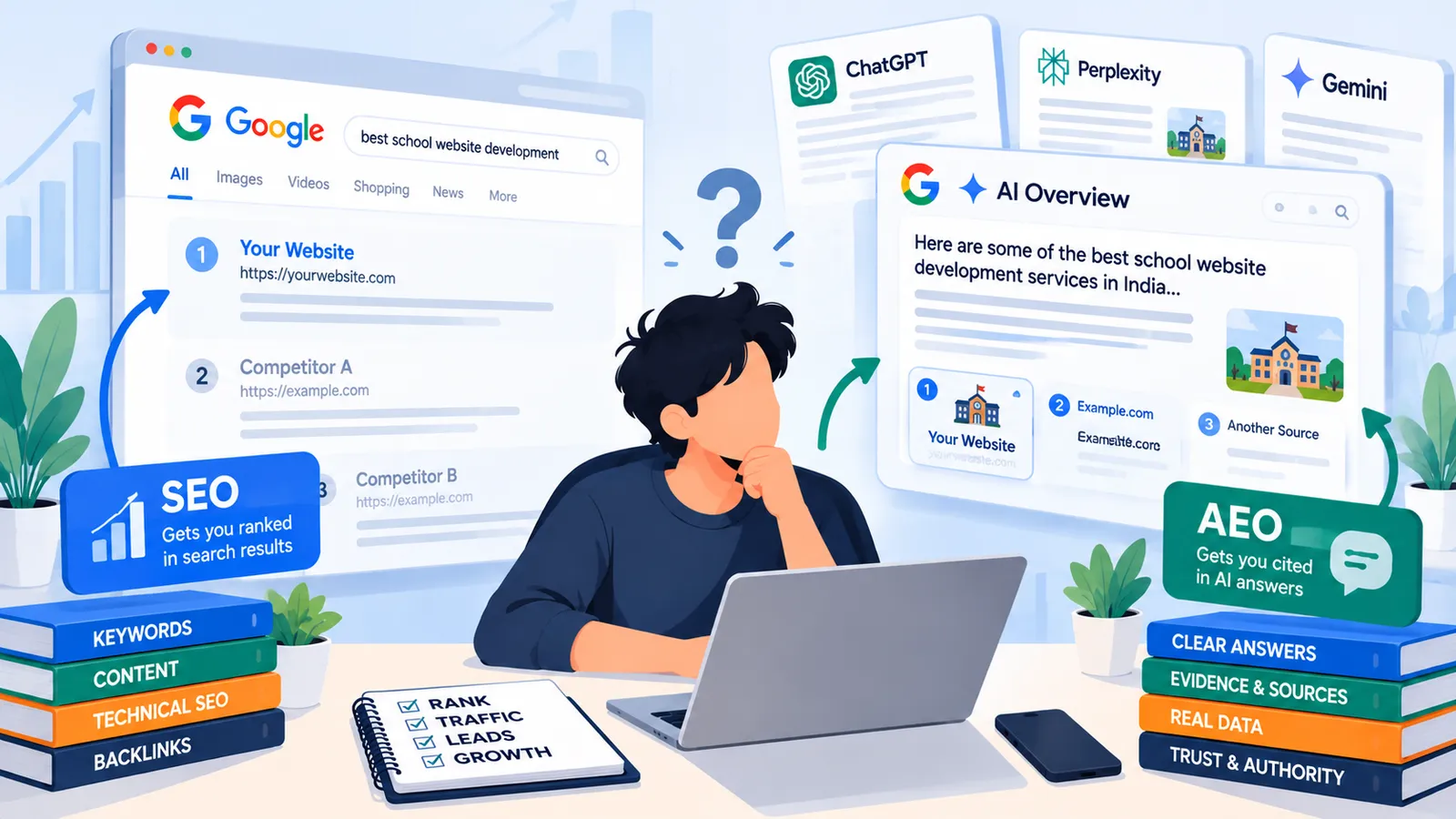
What has AI actually changed about search?
It’s cut clicks on some searches. The clearest evidence we’ve seen comes from Pew Research Center, which tracked real Google searches by 900 US adults in March 2025. With an AI summary on the page, people clicked a normal result link in 8% of visits; without one, they clicked in 15%. Only 1% clicked a link inside the summary.
That’s a real drop. It mostly hits questions with a quick answer, though. “What is a canonical tag?” can be answered in a sentence, so you won’t get many clicks for it. “Best dermatologist near me for acne scars” still ends with a click, a call or a booking.
| Kind of search | Effect of AI answers | What it means for you |
|---|---|---|
| Quick facts and definitions | Fewer clicks; answer shown directly | Aim to be the cited source as well as a ranked link |
| How-to and comparison | Mixed; summary first, then deeper reading | Detailed, specific pages still earn visits |
| Local and buying searches | People still click, call and book | Normal SEO and local profiles still drive customers |
Do AI tools still need SEO?
They do. AI tools that search the web fetch pages much as a search engine does. Google says your page must be indexed and eligible to show a snippet to appear in AI Overviews or AI Mode, with no extra technical requirements. Perplexity says it searches the web live and cites its sources.
Ahrefs looked at 4 million AI Overview citations in March 2026. About 38% of the cited pages also ranked in Google’s top 10, and about 31% ranked between 11 and 100. So ranking alone doesn’t decide who gets cited any more. But if your page isn’t findable and trusted in search, it’s not even in the running.
Is SEO still worth it for a small business?
For most of you, yes. The searches that turn into customers are the ones AI has touched least. Someone looking for a CA in Indore or a builder in Whitefield still compares options, reads reviews and visits your website.
What’s moving is where they first meet you. In BrightLocal’s 2026 survey of US consumers, 45% had used AI tools to find local businesses, up from 6% a year earlier. Those tools draw on the same profiles, reviews and websites your local SEO already looks after. Want an industry example? See real estate SEO in India.
What part of SEO is actually dying?
The shortcuts. If a page was written only to rank, copied from a competitor, padded to a word count or stuffed with keywords, an AI summary can reproduce it in a second. You’ll see those pages lose value first.
Useful, specific content on a site that search engines can crawl easily still works. If you’re planning a rebuild, read our guide to website redesign SEO first.
Why do people keep saying SEO is dead?
It gets attention. And to be fair, something real does change every few years. Mobile search, voice assistants, featured snippets and now AI answers each moved where the clicks went, and each time someone declared SEO finished.
Each time, the easy tactics stopped working and the fundamentals carried on. If you’ve said plainly what you offer, where and for whom, and you’ve published pages that answer real questions, you’ve come through every one of those shifts.
It’s also worth asking who’s saying it. “SEO is dead” often opens a sales pitch for whatever’s being offered as its replacement. Check your own Search Console data before you decide anything.
How to adapt your SEO for AI search: step by step
- Make sure your important pages are indexed. Our guide on why a website doesn’t show up on Google covers the common blockers.
- Search your 10 main topics and note which ones show an AI Overview.
- Rewrite your main pages so a question heading is followed by a direct two-sentence answer.
- Add what AI can’t make up: your prices, your process, your location, your own data and experience.
- Keep your Google Business Profile and reviews up to date. Maps results and AI recommendations both draw on them.
- Track impressions and enquiries, not just clicks. Our free SEO tools cover the basics.
- Read up on the AI side. Start with AEO vs SEO and our guide to Perplexity SEO.
What we would do first
Check your own data before you believe any headline. In Google Search Console, compare impressions and clicks over the last 12 months. If impressions are steady but clicks have fallen on your informational pages, AI summaries are probably taking some of them. If both have fallen, it’s usually something else, and often it’s technical.
Then we’d find which of your pages bring in enquiries, and we’d protect and improve those first. Every engagement in our SEO consulting work starts there.
Frequently asked questions
Will AI replace SEO completely?
We haven’t seen anything that suggests it will. AI tools still need web pages to write their answers from, and Google’s AI features use pages that are indexed and eligible for snippets. The work’s changing shape, that’s all.
Is SEO still relevant in 2026?
Yes, especially for local and buying searches, where people still click, call and book. It matters less for quick factual questions, which AI summaries now answer for you.
Is local SEO dead?
No. People still look for nearby businesses on Google Maps, and AI tools increasingly recommend local businesses using the same profiles and reviews. Your local SEO feeds both.
Should I stop blogging because of AI?
Drop the generic posts that repeat what’s already everywhere. Keep publishing specific, useful pages that answer your customers’ real questions from your own knowledge. That’s the kind AI tools cite.
What’s the difference between SEO and AEO?
SEO aims to rank your pages. AEO aims to get them quoted in AI answers, and it builds on SEO; the steps above link to our full guide.
Not sure what’s happening to your traffic?
House of Ranking is an India-based SEO and AI search consultancy for small and mid-sized businesses. We’ll go through your Search Console data with you and tell you plainly whether AI’s the cause or something else is. Book a free strategy call.
Sources
- Pew Research Center, “Google users are less likely to click on links when an AI summary appears in the results” (July 2025): https://www.pewresearch.org/short-reads/2025/07/22/google-users-are-less-likely-to-click-on-links-when-an-ai-summary-appears-in-the-results/
- Google Search Central, “AI features and your website”: https://developers.google.com/search/docs/appearance/ai-features
- Ahrefs, “Update: 38% of AI Overview Citations Pull From The Top 10” (March 2026): https://ahrefs.com/blog/ai-overview-citations-top-10/
- BrightLocal, “Local Consumer Review Survey 2026”: https://www.brightlocal.com/research/local-consumer-review-survey/
- Perplexity Help Center, “How does Perplexity work?”: https://www.perplexity.ai/help-center/en/articles/10352895-how-does-perplexity-work