What is real estate SEO, and how does it work in India?
Real estate SEO is how you get your website found when people search for property in your area, whether you’re a builder, a broker or an agent. In India that means a page for each locality and project, accurate RERA details, a complete Google Business Profile, genuine reviews, and content that answers your buyers’ actual questions. Get those right and Google and AI tools have a reason to recommend you.
Before you read on:
- Your buyers search by locality, project and budget, so build your pages around those.
- Section 11 of the RERA Act requires the project registration number on your website and in your ads.
- Big portals like 99acres and MagicBricks tend to hold the generic searches. You’ll do better on the specific ones.
- A complete Google Business Profile with real reviews feeds both Maps and AI recommendations.
- SEO brings the enquiry in. How fast you follow up decides whether it becomes a sale.
If you’re a builder in Pune or a broker in Gurugram, the big portals will beat you on almost every generic search. You probably won’t outrank them for “flats for sale”. You don’t need to. The searches worth chasing are the ones they serve badly: your project names, your localities, and the questions only a local expert can answer.
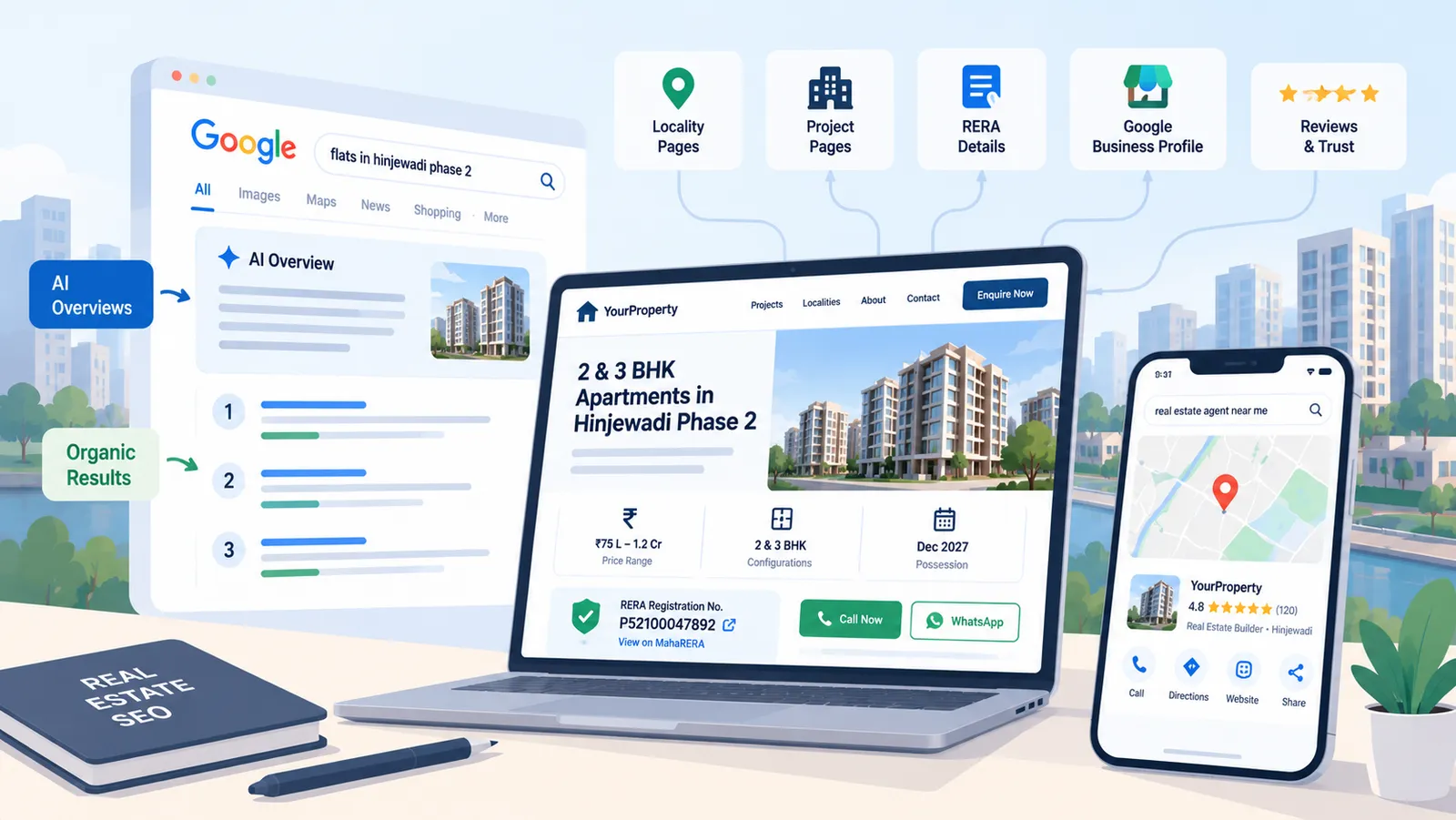
Why is real estate SEO different from other industries?
Property searches are hyperlocal, and the portals own the broad terms. Search “2BHK in Pune” and you’ll mostly see portals. Search “2BHK near Hinjewadi Phase 2 under 80 lakh”, or your project’s name, and it’s a much narrower search. That’s where a well-built page from you has a real chance.
Buying a home also takes a lot of trust. Before your buyers call, they’ll check registration details, your track record and your reviews. So your website has to answer those checks, not just rank.
What pages does a real estate website need?
Give each thing your buyers search for its own clear page. Plenty of property sites have a homepage, a grid of projects and a contact form, with nothing that answers a search at locality level.
| Page | What it should cover | Who it’s for |
|---|---|---|
| Project page | Configurations, carpet area, price range, possession date, RERA number, amenities, location map | Buyers comparing specific projects |
| Locality page | Connectivity, schools, hospitals, price trends you can source, your listings there | Buyers choosing an area |
| Buyer guide | Home loan steps, stamp duty, documents, possession checks | First-time buyers researching |
| About and team | Years in business, past projects, registration details | Buyers checking trust |
| FAQ | Real questions from enquiries, answered in 2 to 4 sentences | Everyone, plus AI answers |
Do you need to show RERA details on your website?
For registered projects, yes. Under Section 11 of the Real Estate (Regulation and Development) Act, 2016, as Andhra Pradesh RERA’s advertisement guidelines put it, a promoter must “mention the registration number of the project provided by the authority on the website as well as on any advertisement.” Several state authorities have also issued their own directions on how prominently it should appear.
It helps you, too. A visible RERA number linked to your state’s RERA listing reassures buyers, and it gives search engines and AI tools a fact they can check. Look up your own state authority’s guidelines for the exact format.
How does Google Business Profile help real estate SEO?
It gets you into the map results. When someone searches “real estate agent near me” or “property dealer in Baner”, Google shows a map pack of local businesses above most websites. You’ll get in with a complete profile: the right category, your service areas, photos, hours and reviews.
In BrightLocal’s 2026 survey of US consumers, 97% said they read reviews for local businesses, and 45% had used AI tools for local recommendations. We haven’t found a comparable Indian figure. But your buyers check reviews too, and AI tools read the same profiles.
How does AI search change real estate SEO?
Some of your buyers now ask AI tools questions like “which builders in Chennai deliver on time?” The answers draw on whatever the tools can find and cross-check: your website, your Google profile, news coverage, portal listings and forum threads.
So consistency matters. If your website, Google profile and portal listings show different names, addresses or project details, an AI tool has less reason to recommend you. For the wider picture, read AEO vs SEO and our earlier guide on how to get your business mentioned in ChatGPT.
Real estate SEO step by step
- List the searches you can win: your project names, your localities and your buyers’ specific questions. Leave the city-wide terms to the portals.
- Build a page for each project and each locality. Follow the table above, and write your own descriptions instead of copying portal text.
- Show your RERA numbers clearly, each linked to the official state RERA listing.
- Complete your Google Business Profile with the right category, your service areas, real photos and current hours.
- Ask happy buyers for reviews, for example after possession or registration. Never pay for them or script them.
- Keep your enquiry options quick: phone, WhatsApp and a short form. If a lead waits too long, they’ll usually call the next builder.
- Check your site’s basics. Our free SEO checklist covers speed, mobile and indexing.
If you’re rebuilding your website as part of this, protect your existing rankings first: keep your current URLs or redirect each one to its new page. Our website redesign SEO checklist walks through every step.
What we would do first
Search the way your buyer would. Type in your project names, your localities with “flats” or “plots”, and “builders in” followed by your area. Each time, note who shows up: you, a portal or a competitor. That list shows you where the realistic wins are.
Next, we’d go through your project pages for RERA details, specifics and enquiry options, and check your Google Business Profile for gaps. Content and links come later. That’s how we work with real estate businesses under our local SEO service.
Related reading: Perplexity SEO and is SEO dead because of AI?.
Frequently asked questions
Can a small broker compete with 99acres and MagicBricks on Google?
On broad searches like “flats in Mumbai”, rarely. On searches for a specific locality, project or question, you can rank well with detailed, accurate pages. That’s where we’d put your effort.
How long does real estate SEO take?
Usually months. Your project and locality pages can start appearing within weeks of being indexed, but competitive searches take longer. If someone guarantees you quick top rankings, they’re overpromising.
Should each project have its own page?
Yes. Each project has its own name, location, configurations and RERA number, and buyers search for projects one at a time. A page per project gives each of them a chance to rank.
Do real estate SEO services include Google Business Profile?
Good ones do, because so many local property searches end in the map pack. Ask any provider exactly what they’ll change on your profile and how they’ll handle your reviews.
Is it worth listing on property portals as well?
Usually, yes. Portals bring their own traffic, and consistent listings help AI tools confirm your details. Just make sure your own website stays the most complete source on your projects.
Want to know where your property site stands?
House of Ranking is an India-based SEO and AI search consultancy for small and mid-sized businesses, including builders and brokers. We’ll check how your projects show up on Google and in AI answers, and tell you what to fix first. Book a free strategy call.
Sources
- Andhra Pradesh RERA, “Advertisement guidelines” (Section 11, RERA Act 2016): https://rera.ap.gov.in/RERA/Views/AdvertisementGuidelines.aspx
- BrightLocal, “Local Consumer Review Survey 2026”: https://www.brightlocal.com/research/local-consumer-review-survey/
- Google Search Central, “AI features and your website”: https://developers.google.com/search/docs/appearance/ai-features